

Busan has that rare mix that keeps first-timers relaxed: a big-city food scene, breezy seaside neighborhoods, and mountains close enough to appear at the end of ordinary streets. You can spend the morning in a temple courtyard, the afternoon on a beach boardwalk, and still be back at your guesthouse in time for a late seafood dinner.
It’s also an easy city to learn quickly. The subway is straightforward, taxis are reliable, and many of the best moments happen in places that don’t require planning—market alleys steaming with broth, harbor sidewalks at sunset, and café windows facing the water.
This guide is built for international travelers staying at a guesthouse: practical routes, low-stress timing, and the kind of tips you’ll actually use when you’re walking out the door with a daypack and a transit card.
Key Takeaways
- Base yourself near a subway line (Seomyeon, Nampo, or Gwangan/Haeundae) to keep transfers simple.
- Go early for temples and skywalks, go late for markets and beach nightlife.
- Carry a light layer—Busan’s sea breeze can feel cooler than the temperature suggests.
- Use markets for affordable meals; you can eat well without booking anything.
- Pick one “east coast day” (Haeundae area) and one “old port day” (Nampo/Yeongdo) to avoid crisscrossing the city.
1. Gamcheon Culture Village (감천문화마을): Colorful Hills and Real Neighborhood Life
Gamcheon is famous for its painted houses and hillside views, but what makes it worth your time is the layout: staircases, tiny lanes, and lookouts that open up suddenly to the sea. It’s part photo walk, part neighborhood wander.
Why it’s worth visiting: You get a feel for Busan’s hillside geography in one place—how homes, shops, and viewpoints stack up above the port. It’s also one of the best spots for morning light if you’re taking photos.
Practical tips:
- Arrive earlier than you think (late morning gets crowded). The lanes are narrow and it’s more enjoyable before tour groups arrive.
- Wear shoes with grip—there are steep steps and uneven pavement.
- Be mindful that people live here: keep voices low, don’t block doorways, and avoid photographing residents up close.
- If you’re staying at a guesthouse in Nampo/Jagalchi, this is an easy half-day with a short bus/taxi ride.
2. Jagalchi Market + BIFF Square: The Easiest Way to Eat Like You’re in Busan
If you want a single area that screams “port city,” this is it. Jagalchi is all salt air and seafood tanks, while BIFF Square nearby is street snacks, neon signs, and the feeling that dinner could turn into a whole evening.
Why it’s worth visiting: It’s the fastest route to classic Busan food without needing reservations or Korean fluency. Point, order, eat—then wander to the next thing.
Practical tips:
- Go hungry and share dishes if you’re traveling with someone—markets are best when you try a few things.
- Expect some English, but not everywhere. A translation app helps for specific fish names.
- Look for hot snacks in BIFF Square like ssiat hotteok (seed-filled pancake). It’s a small Busan ritual.
- Many stalls are cash-friendly, but card works widely. Keep a little cash for quick bites.
3. Haedong Yonggungsa Temple (해동용궁사): A Coastal Temple That Feels Like a Day Trip
Most temples sit in mountains. This one sits on the sea—stone steps down to the water, lanterns in the wind, and waves breaking behind the shrines. Even if you’re not “a temple person,” the setting is hard to beat.
Why it’s worth visiting: The ocean backdrop is the star. It’s also a refreshing change from central Busan—more sky, more horizon, fewer tall buildings.
Practical tips:
- Start early to avoid the biggest crowds and to get softer light for photos.
- Bring water; the stairs add up, especially in summer humidity.
- Combine it with a beach afternoon in Haeundae/Songjeong so the longer transit feels “worth it.”
- Dress respectfully (no need for anything formal, just avoid beachwear inside sacred areas).
4. Haeundae Beach + Dalmaji-gil: The Classic Seaside Walk With a Calm Escape
Haeundae is the headline beach, and yes, it can be busy. The trick is to enjoy the shore when it’s lively, then slip into Dalmaji-gil (the hill road) for a slower, greener walk with viewpoints and cafés.
Why it’s worth visiting: You get both versions of Busan in one afternoon: energetic beachfront and quiet scenic corners just uphill.
Practical tips:
- Sunset is prime time on the sand. If you want space, go in the morning for a calmer vibe.
- For guesthouse travelers, Haeundae is easy if you base yourself on Line 2 (Gwangan/Haeundae area) or don’t mind a transfer from Seomyeon.
- Dalmaji-gil is best with comfortable shoes—gentle hills, not intense, but steady.
- Convenience stores near the beach make a budget-friendly picnic: kimbap, fruit, and cold drinks.
5. Gwangalli Beach (광안리) at Night: Bridge Lights and an Unplanned Good Time
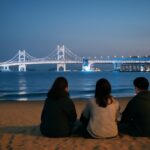
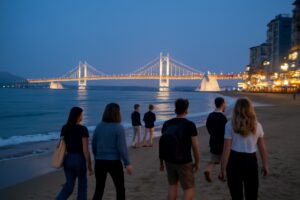
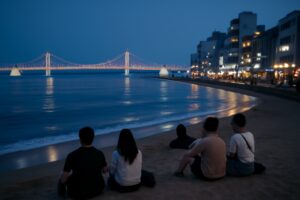
Gwangalli is where Busan feels most effortlessly social. The beach faces Gwangan Bridge, and after dark the lights reflect on the water while cafés and casual bars fill up behind the sand.
Why it’s worth visiting: It’s one of the best “do nothing” places in the city—and sometimes that’s exactly what you need after a day of stairs and transit.
Practical tips:
- Go after dinner and take your time. This is a linger spot, not a checklist stop.
- If you’re staying in a guesthouse nearby, it’s perfect for a late walk without worrying about the last train.
- Grab a takeaway drink or dessert and sit on the sand—simple, cheap, memorable.
- Sea air can be surprisingly cool at night; pack a light jacket even in warmer months.
6. Taejongdae (태종대): Cliffs, Pines, and the Feeling of Leaving the City Behind
Taejongdae is all coastal forest paths and big views—waves far below, wind through pine trees, and lookout points that make Busan’s scale feel real. It’s one of the best nature fixes without going far.
Why it’s worth visiting: It’s dramatic in a quiet way: cliffs, ocean, and walking trails that feel like a reset button.
Practical tips:
- Give yourself a half-day and don’t rush. The best part is walking between viewpoints.
- Bring snacks if you’re budget-minded; guesthouse breakfasts are usually light, and you’ll be glad for extra fuel.
- Check the weather—clear days make the views shine, but even misty days feel atmospheric.
- Pair it with an evening in Nampo if you want to end the day back in the market zone.
7. Seomyeon (서면): The Most Useful Neighborhood for Guesthouse Travelers
Seomyeon isn’t a “must-see” landmark, and that’s exactly why it matters. It’s the kind of place you’ll return to because it’s convenient: transport connections, affordable meals, and a steady hum of local life.
Why it’s worth visiting: It’s a practical hub for first-timers—great if you want to bounce between the beach side and the port side without spending your whole trip transferring lines.
Practical tips:
- Use Seomyeon as your “reset zone” for laundry cafés, pharmacies, and easy dinners near your guesthouse.
- Look for small restaurants with photo menus—common in busy areas and helpful if you’re ordering in English.
- Evenings are lively; if you’re a light sleeper, choose a guesthouse room away from main roads.
- If you’re arriving by train or long-distance bus, Seomyeon makes a low-stress first base for learning transit.
8. Guesthouse-Friendly Transit and Day Planning: How to Make Busan Feel Easy
Busan can look spread out on a map, but it becomes simple when you group your days by area. A guesthouse base works best when you don’t zigzag across town for one photo spot at a time.
Why it’s worth doing: Less time commuting means more time eating well, walking slowly, and discovering the small streets that don’t show up on itineraries.
Practical tips:
- Group by geography: Do Nampo/Jagalchi/Gamcheon on one day; do Haeundae/Gwangalli/Haedong Yonggungsa on another.
- Use a transit card: Pick up a T-money or Cashbee card at a convenience store; it saves time on buses and the subway.
- Build in a “laundry + café” hour: Guesthouse travel is easier when you plan one slow hour every two days.
- Don’t underestimate buses: They often get you closer than the subway, especially for coastal parks and hillside areas.
- Keep one flexible night: Use it for whatever you liked most—bridge views, market snacking, or a quiet beach walk.


No comment yet, add your voice below!